Gluco6 vs Sugar Defender (2026): Ingredients, Safety & Which Is Worth Considering?
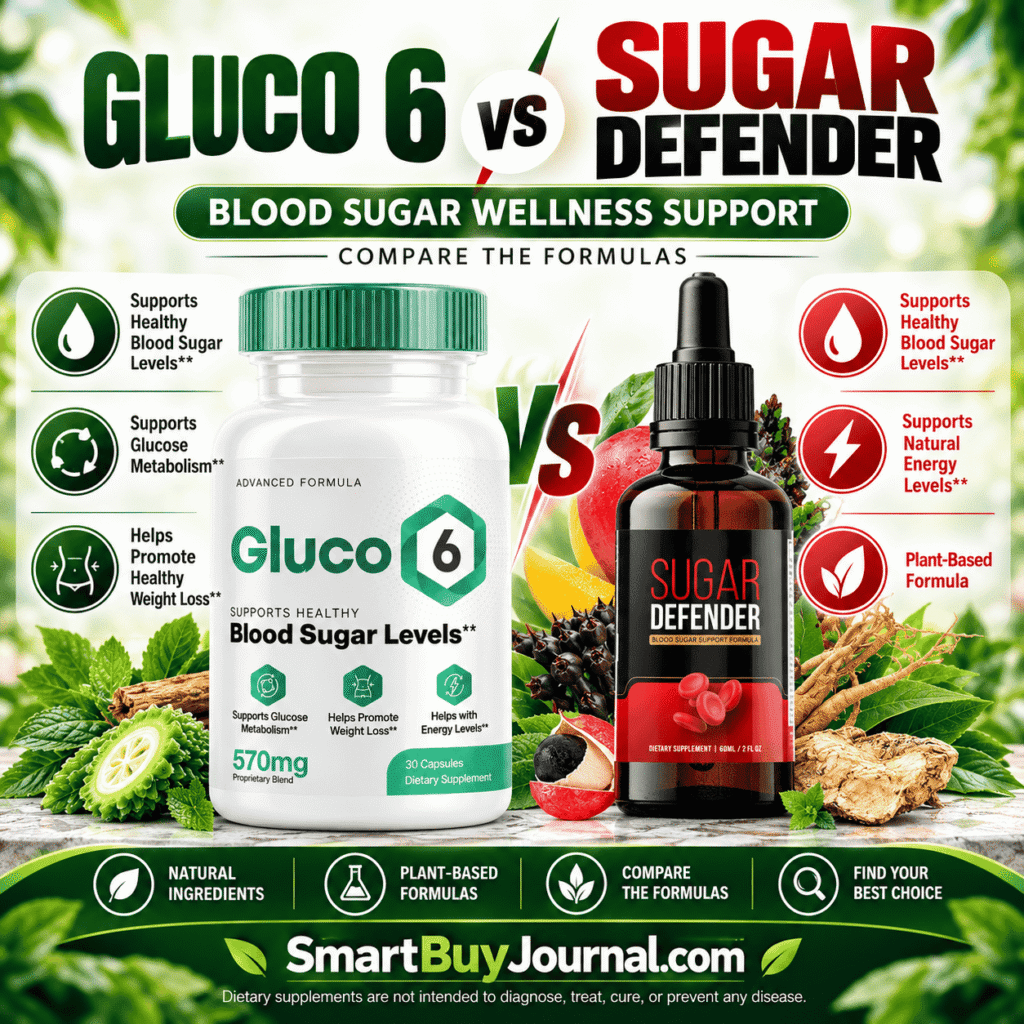
Choosing between Gluco6 vs Sugar Defender requires more than comparing sales pages or reading testimonials. Both products are marketed as dietary supplements for blood sugar support, but the most important questions are whether their complete formulas and doses are clearly disclosed, whether the finished products have been clinically tested, how their safety information is presented, and whether the purchase terms are easy to verify.
This comparison reviews the available product information without treating ingredient research as proof that either finished supplement works. It also does not replace medical care. People with diabetes, prediabetes, hypoglycemia, kidney or liver disease, or anyone taking glucose-lowering medication should speak with a qualified healthcare professional before using either product.
Quick answer: Gluco6 vs Sugar Defender
There is no well-established basis for declaring a universal winner. The better choice depends first on label transparency, verified dosing, safety information, and purchase terms, not on the strongest marketing language.
Based on the information that could be responsibly assessed:
- Neither product should be treated as a replacement for prescribed diabetes treatment, nutrition changes, physical activity, or glucose monitoring.
- Ingredient-level studies do not automatically prove that either finished product lowers blood glucose or improves long-term health outcomes.
- A product should not be considered “clinically proven” unless the finished formula has been tested in appropriate human trials.
- Exact ingredient quantities, current prices, package options, and refund conditions should be confirmed on the live sales page before purchase.
- Anyone using insulin or another blood sugar medication should obtain professional advice first because some supplements may affect glucose levels or medication response.
Gluco6 vs Sugar Defender comparison table
| Category | Gluco6 | Sugar Defender |
|---|---|---|
| Product type | Blood sugar support supplement | Blood sugar support supplement |
| Intended purpose | Marketed for glucose and metabolic support | Marketed for glucose and metabolic support |
| Complete formula | Verify on the current product label | Verify on the current product label |
| Exact ingredient doses | Must be confirmed before purchase | Must be confirmed before purchase |
| Finished-product clinical trial | No product-specific trial was verified in the sources reviewed | No product-specific trial was verified in the sources reviewed |
| Prescription medicine replacement | No | No |
| Recommended use | Follow the current label only | Follow the current label only |
| Safety | Depends on ingredients, doses, health conditions, and medicines | Depends on ingredients, doses, health conditions, and medicines |
| Current price | Subject to change; verify at checkout | Subject to change; verify at checkout |
| Refund policy | Confirm the current terms | Confirm the current terms |
| Best suited to | Readers who value a clearly disclosed formula and verifiable purchase terms | Readers who value a clearly disclosed formula and verifiable purchase terms |
| Main limitation | Product-specific outcome evidence may be limited | Product-specific outcome evidence may be limited |
The table deliberately avoids presenting unverified prices, ingredient amounts, or refund periods as facts. Supplement sales pages can change, and a product’s exact formula may differ between versions or markets.
What are Gluco6 and Sugar Defender?
Gluco6 and Sugar Defender are marketed as dietary supplements intended to support healthy blood sugar and metabolic function. Products in this category commonly promote ingredients associated with glucose metabolism, insulin sensitivity, antioxidant activity, appetite control, or energy production.
Those proposed roles should be separated into three different levels of evidence:
- Marketing claims made by the seller.
- Ingredient-level research involving a particular nutrient, herb, or plant compound.
- Finished-product evidence showing whether the exact formula, at its labeled dose, produces meaningful outcomes in humans.
The third category is the most relevant to a buying decision, but it is often the least available for commercial supplements. Research on one ingredient cannot establish that a multi-ingredient product works as advertised. The dose, extraction method, formulation, duration of use, participant characteristics, and outcome measures all matter.
What this comparison can and cannot establish
This article can help readers assess:
- Whether product information is transparent.
- What evidence would be needed to support common blood sugar claims.
- Which safety questions should be considered.
- Why supplement marketing should not replace medical evaluation.
- What to verify before ordering either product.
It cannot determine an individual’s medical need for a supplement or predict how either product will affect a particular person.
Gluco6 review: what to assess
Gluco6 is presented as a blood sugar support supplement. The most useful way to evaluate it is to examine the current label and product documentation rather than relying on promotional statements alone.
Gluco6 ingredients and formulation
Before purchasing Gluco6, check whether the current product page clearly identifies:
- Every active ingredient.
- The amount of each ingredient per serving.
- Serving size and number of servings per container.
- The form of each ingredient, such as an extract, powder, mineral, or standardized compound.
- Other ingredients, including capsules, flow agents, sweeteners, or colorants.
- Allergen information.
- Manufacturer or distributor details.
- Lot, expiration, and storage information where provided.
A formula that lists exact amounts is easier to evaluate than a proprietary blend that gives only a combined total. Without individual quantities, it is difficult to compare the product with research studies or judge whether an ingredient is present at a meaningful amount.
Ingredient-level evidence is not product-level proof
Even if Gluco6 contains ingredients that have been studied for glucose metabolism, that does not show that Gluco6 itself has been proven effective. A credible product-specific claim would ideally be supported by a randomized, controlled human study of the finished formula, with:
- A clearly identified product.
- A stated dose.
- An appropriate comparison group.
- A sufficient study duration.
- Clinically relevant outcomes.
- Transparent reporting of adverse events.
- Publication in a credible scientific source.
No such product-specific clinical trial for Gluco6 was verified in the sources reviewed for this comparison. That does not prove that no study exists anywhere; it means readers should not assume product-level proof without locating and reviewing one.
Potential advantages of Gluco6
Potential advantages may include:
- It may offer a convenient supplement format.
- A clearly labeled formula could make ingredient assessment easier.
- Some ingredients commonly used in this category have plausible biological mechanisms.
- The product may appeal to people looking for general metabolic support rather than a prescription treatment.
These are practical or theoretical points, not guaranteed health outcomes.
Limitations of Gluco6
Important limitations include:
- The finished product may not have robust clinical evidence.
- Ingredient effects can vary according to dose, preparation, and individual factors.
- Marketing language can be broader than the evidence.
- A supplement may create false confidence and delay appropriate medical testing.
- The safety profile depends on the full formula and the user’s medications and conditions.
- Current price, shipping terms, and refund conditions must be confirmed from the active sales page.
For product-specific details, see the Gluco6 review page on SmartBuyJournal.com.
Sugar Defender review: what to assess
Sugar Defender is also marketed as a supplement for blood sugar and metabolic support. As with Gluco6, the appropriate evaluation starts with the current label, directions, warnings, manufacturer details, and purchase terms.
Sugar Defender ingredients and formulation
The current product page should be checked for:
- A complete ingredient list.
- Exact amounts per serving.
- The recommended serving size.
- The form and standardization of botanical ingredients.
- A list of inactive ingredients.
- Potential allergen information.
- Manufacturer contact information.
- Storage and expiration information.
- Warnings and use restrictions.
Do not assume that a product contains an ingredient merely because a sales page mentions its general category. The label is the controlling source for the actual formulation.
If an ingredient is listed without its amount, or if several ingredients are grouped into a proprietary blend, readers cannot reliably compare the formula with human studies. This is especially important for supplements that make strong claims about insulin, glucose, cravings, or weight.
Potential advantages of Sugar Defender
Potential advantages may include:
- Convenient use for people who prefer a supplement format.
- A formula that may contain ingredients traditionally associated with metabolic support.
- Availability through an online product page.
- The possibility of comparing its label with other products before buying.
These points do not establish effectiveness.
Limitations of Sugar Defender
Potential concerns include:
- Lack of verified clinical evidence for the finished product.
- Uncertainty about whether the doses match those used in research.
- Possible interactions with diabetes medicines or other supplements.
- Sales-page claims that may not be independently validated.
- Changing price, package, delivery, or refund information.
- The risk that users interpret “support” language as treatment advice.
For product-specific information, see the Sugar Defender review page on SmartBuyJournal.com.
Ingredients: how to evaluate blood sugar supplements
A comparison of Gluco6 vs Sugar Defender should not stop at counting ingredients. More ingredients do not necessarily mean a better product. The most useful questions are:
- Is the ingredient identity clear?
- Is the amount disclosed?
- Is the form or extract standardized?
- Is there human research relevant to the intended use?
- Does the research involve the same dose and preparation?
- Are the possible benefits clinically meaningful?
- Could the ingredient cause harm or interact with medication?
Common ingredient categories
Blood sugar supplements may include nutrients, minerals, herbs, plant extracts, fibers, or compounds involved in carbohydrate metabolism. Their evidence and safety profiles differ substantially.
Berberine
Berberine is a plant-derived compound frequently discussed in blood sugar supplement marketing. Some clinical research has examined berberine in people with metabolic conditions, and results suggest that it may influence glucose and lipid measures in certain settings.
However, several cautions matter:
- Research findings are not uniform.
- Preparations and doses vary.
- Product quality can differ.
- Berberine can interact with medicines.
- Gastrointestinal side effects are possible.
- It should not be treated as a substitute for prescribed diabetes therapy.
Pregnant or breastfeeding individuals should not use berberine without explicit advice from a qualified clinician. People taking glucose-lowering drugs, anticoagulants, immunosuppressants, or other medicines should ask a pharmacist or physician about potential interactions.
Cinnamon
Cinnamon is often included because some studies have examined its possible effects on blood glucose. Findings have been mixed, and the type of cinnamon can matter. Cassia cinnamon may contain more coumarin than Ceylon cinnamon, and regular high exposure to coumarin can be a concern for the liver in susceptible people.
A label should identify the type and amount of cinnamon where possible. Cinnamon should not be assumed to produce a predictable or clinically significant glucose reduction.
Chromium
Chromium is a mineral involved in normal nutrient metabolism. Supplements are sometimes marketed for insulin or glucose support. Research results have not established a universal benefit for people with diabetes or for the general population.
Excessive intake may cause adverse effects, and people with kidney or liver problems should be especially cautious. The amount and chemical form should be disclosed on the label.
Bitter melon
Bitter melon has been studied for possible glucose-related effects, but the evidence is limited and variable. It may cause digestive symptoms and could potentially add to the glucose-lowering effects of medication.
Anyone taking insulin or other diabetes medicines should obtain professional advice before using a product containing bitter melon.
Gymnema
Gymnema is a botanical ingredient used in some traditional and supplement products. Early research has explored possible effects on glucose and taste perception, but the quality and scope of evidence vary.
Potential interactions are important because an ingredient that affects blood glucose could increase the risk of low blood sugar when combined with medication.
Alpha-lipoic acid
Alpha-lipoic acid is an antioxidant compound used in some metabolic and nerve-health products. It has been studied in certain contexts involving diabetic neuropathy, but evidence for general blood sugar control is not the same as evidence for relief of a specific nerve-related condition.
Possible side effects include gastrointestinal symptoms and, in some circumstances, changes in blood glucose. The exact role of this ingredient depends on the dose and the individual’s health status.
Fiber ingredients
Soluble fiber can slow digestion and may support improved blood glucose control as part of an overall dietary pattern. Fiber is not a quick substitute for dietary management, and the amount used in a capsule or gummy may be much lower than amounts studied in dietary research.
Sudden increases in fiber can cause bloating or altered bowel habits. Fiber can also affect the absorption of some medicines, so timing may need professional review.
Vitamins and minerals
A vitamin or mineral may be useful when a person has a documented deficiency, but more is not necessarily better. Supplements should not be used to correct a presumed deficiency without appropriate assessment, particularly when high doses may be harmful.
The label should identify the dose and percentage of the daily value. Claims that a vitamin “supports metabolism” do not necessarily mean that supplementation improves glucose control in someone who already has adequate intake.
What does the science say?
Blood glucose is a medical issue, not just a supplement category
Blood glucose can be affected by food, activity, sleep, stress, illness, body composition, hormones, genetics, and medication. Persistently elevated glucose may indicate prediabetes or diabetes, while unexpectedly low glucose may also require prompt assessment.
The Centers for Disease Control and Prevention explains that prediabetes and type 2 diabetes are identified through blood tests rather than supplement marketing claims. The CDC information on prediabetes and the National Institute of Diabetes and Digestive and Kidney Diseases guidance on diabetes tests are useful starting points.
A supplement cannot diagnose the cause of high glucose, determine whether insulin is needed, or confirm that a person’s treatment plan is working.
Evidence for ingredients versus evidence for products
When a product page cites research, check what was actually studied:
- Was it the same finished product?
- Was it the same combination of ingredients?
- Was the dose the same?
- Were participants similar to the intended customers?
- Were outcomes measured over a meaningful period?
- Was the study randomized and controlled?
- Were side effects reported?
If the answer to these questions is unknown, the evidence should be described as indirect.
For example, a study of an isolated botanical extract does not establish that a capsule containing a small amount of that botanical plus several other ingredients will have the same effect. Nor does a laboratory study establish a reliable human benefit.
What a strong study would show
For a supplement intended to support glucose health, useful clinical outcomes might include changes in:
- Fasting blood glucose.
- Hemoglobin A1c.
- Post-meal glucose.
- Insulin sensitivity measures.
- Medication requirements under medical supervision.
- Adverse events and treatment discontinuations.
A short-term change in a single measurement may not translate into reduced risk of complications. Long-term health outcomes are more difficult to study but are highly relevant.
What health authorities say about supplements
The National Center for Complementary and Integrative Health notes that natural products can have biological effects, interact with medicines, and vary in quality. Its information on diabetes and complementary health approaches explains why supplement use should be discussed with a healthcare professional.
The U.S. Food and Drug Administration also explains that dietary supplements are not approved in the same way as prescription medicines for safety and effectiveness before sale. Its dietary supplement information for consumers is relevant when assessing marketing claims and product quality.
This does not mean every supplement is ineffective or unsafe. It means consumers must distinguish between a product being legally sold and a product having strong clinical evidence for a specific outcome.
Gluco6 vs Sugar Defender: safety comparison
Safety is one of the most important differences between products, but it cannot be judged from the product name or marketing category alone.
Possible side effects
Depending on the ingredients, blood sugar supplements may cause:
- Nausea.
- Abdominal discomfort.
- Diarrhea or constipation.
- Headache.
- Dizziness.
- Changes in appetite.
- Allergic reactions.
- Changes in blood glucose.
- Liver or kidney concerns in susceptible individuals.
A serious reaction requires prompt medical attention. Symptoms such as confusion, fainting, severe weakness, trouble breathing, swelling of the face or throat, persistent vomiting, or signs of very low blood glucose should not be managed by simply taking another supplement.
Medication interactions
The greatest practical concern is often interaction with existing treatment. Possible issues include:
- Additive glucose-lowering effects with insulin or diabetes medication.
- Altered drug absorption.
- Effects on blood pressure.
- Effects on blood clotting.
- Changes in liver enzyme activity.
- Interactions with medicines that have a narrow therapeutic range.
People should provide their healthcare professional with the full supplement label, not just the product name.
Who should be especially cautious?
Professional advice is particularly important for people who:
- Have diabetes or prediabetes.
- Have experienced hypoglycemia.
- Use insulin, sulfonylureas, or other glucose-lowering medication.
- Are pregnant, trying to become pregnant, or breastfeeding.
- Have kidney or liver disease.
- Have a history of eating disorders.
- Are preparing for surgery.
- Take anticoagulants, immunosuppressants, or multiple prescription medicines.
- Are under 18.
- Have allergies to botanical ingredients.
Do not stop or change prescribed treatment because of claims made on a supplement sales page.
Quality and contamination concerns
Supplement quality can vary. Consumers should look for:
- A complete and readable label.
- A traceable manufacturer.
- Lot and expiration information.
- Independent quality testing when available.
- Clear contact information.
- No unexplained disease-treatment claims.
- No pressure to use the product instead of medical care.
Third-party certification can provide useful information about manufacturing or testing, but it does not prove that the supplement is effective for blood sugar control.
How to use Gluco6 or Sugar Defender
Use either product only according to the current official label. Do not exceed the suggested serving, combine multiple glucose-support supplements, or use a product to compensate for a high-risk diet or missed medical treatment.
Because the available product information may change, verify:
- Serving size.
- Time of day.
- Whether the product should be taken with food.
- Duration of use.
- Storage instructions.
- Warnings.
- What to do if a serving is missed.
If the instructions conflict with advice from a healthcare professional, follow the professional’s advice and clarify the discrepancy before using the product.
Do not use home glucose readings to experiment with changing prescription doses without medical supervision.
Pricing, packages, shipping, and refunds
Prices and package offers can change frequently. The safest practice is to check the active checkout page immediately before ordering.
For both Gluco6 and Sugar Defender, verify:
- The price per bottle.
- Whether a subscription is selected by default.
- The number of servings per bottle.
- Shipping and handling charges.
- Any sales tax.
- Whether international delivery is available.
- The billing date for recurring orders.
- The refund period.
- Return-shipping requirements.
- Whether opened products qualify for a refund.
- The correct customer-service contact method.
A large discount does not necessarily represent the lowest total cost if the offer requires multiple bottles or recurring billing.
Do not rely on a refund statement shown in an advertisement if the full terms are not available. Save the order confirmation and refund policy at the time of purchase.
Gluco6 vs Sugar Defender: which may be worth considering?
A reasonable decision framework is more useful than a blanket winner.
Gluco6 may be worth considering only if:
- The current label clearly discloses all ingredients and amounts.
- The seller provides understandable directions and warnings.
- You have reviewed possible medication interactions.
- The total cost and refund terms are clear.
- You understand that ingredient research is not proof of product effectiveness.
- You are using it only as a possible supplement to, not a replacement for, appropriate care.
Sugar Defender may be worth considering only if:
- The current product label is complete and readable.
- The serving size and ingredient quantities are disclosed.
- The seller explains purchase and cancellation terms clearly.
- You have reviewed the formula with a healthcare professional when appropriate.
- You are not interpreting marketing claims as evidence of diabetes treatment.
- The cost is acceptable without creating pressure to purchase a large package.
Which one has better evidence?
Neither product should be described as the clear evidence-based winner unless reliable, product-specific human trials can be verified. Evidence about individual ingredients may make a formula scientifically plausible, but plausibility is not the same as demonstrated benefit.
Which one is safer?
The safer option cannot be determined solely by the brand name. It depends on:
- The complete formula.
- Ingredient amounts.
- Product quality.
- The user’s medical history.
- Prescription and nonprescription medicines.
- Whether glucose is monitored appropriately.
- Whether the product is used as directed.
A product with fewer ingredients is not automatically safer, and a “natural” product is not automatically risk-free.
Which one is better for diabetes?
Neither should be used to treat diabetes without guidance from a qualified healthcare professional. Diabetes management may involve nutrition, physical activity, glucose monitoring, medication, and regular assessment for complications. A supplement cannot replace that care.
Pros and cons
Gluco6
Potential pros
- May be convenient for people seeking a supplement format.
- Can be assessed through its current label and product documentation.
- May include ingredients with some preliminary or indirect research.
- Can be compared with other products using dose and transparency criteria.
Potential cons
- Product-specific clinical evidence was not verified.
- Ingredient doses and formulation details must be confirmed.
- Possible interactions may be relevant for people using glucose-lowering medication.
- Price and refund terms may change.
- Marketing claims may be broader than the evidence.
Sugar Defender
Potential pros
- Convenient supplement format.
- May appeal to consumers looking for general metabolic support.
- Its formula can be evaluated if the current label gives exact amounts.
- Online purchase terms can be reviewed before ordering.
Potential cons
- Product-specific effectiveness remains uncertain without appropriate clinical trials.
- Ingredient-level research may not match the actual formula or dose.
- Possible side effects and interactions depend on the full label.
- Price, subscriptions, shipping, and refund details require verification.
- It should not be viewed as a diabetes treatment.
Practical checklist before buying either supplement
Use this checklist when comparing Gluco6 and Sugar Defender:
- Read the Supplement Facts panel, not only the headline claims.
- Confirm the amount of every active ingredient.
- Check whether the product uses a proprietary blend.
- Look for manufacturer contact information.
- Review the warnings and contraindications.
- Check the total checkout price, including shipping and recurring charges.
- Read the complete refund policy.
- Search for a finished-product clinical trial, not just studies of separate ingredients.
- Ask a pharmacist about interactions if you use medication.
- Do not discontinue prescribed treatment.
- Be cautious of guaranteed or rapid-result claims.
- Avoid products that discourage medical testing or professional advice.
Readers interested in practical supplement-use guidance may also want to review SmartBuyJournal’s article on sugar-control gummies, useful tips, and common mistakes.
For information about a related glucose-health concern, see glucose in urine: possible causes and what it may mean. Urine glucose is not a substitute for appropriate blood testing or professional evaluation.
Frequently asked questions
Is Gluco6 better than Sugar Defender?
There is not enough verified product-specific evidence to declare one universally better. Compare the current labels, ingredient doses, safety warnings, total cost, refund conditions, and available clinical evidence.
Do Gluco6 and Sugar Defender treat diabetes?
They should not be considered diabetes treatments. Dietary supplements cannot replace diagnosis, prescribed medication, glucose monitoring, nutrition guidance, or follow-up care.
Are the ingredients in these products clinically proven?
An ingredient may have human research without the finished product being clinically proven. To support a product-level claim, research should test the exact formula and dose in appropriate human participants.
Can I take one of these supplements with metformin or insulin?
Do not assume that combining them is safe. Some ingredients may affect glucose levels or medicine metabolism. Ask a physician or pharmacist before using either product with metformin, insulin, sulfonylureas, or other diabetes medication.
How quickly should a blood sugar supplement work?
There is no reliable general timetable. Claims of immediate or guaranteed results should be treated cautiously. A meaningful assessment requires attention to the exact outcome, time period, diet, medication, and medical context.
Can a supplement lower A1c?
Some individual ingredients have been studied for glucose-related outcomes, but this does not prove that either Gluco6 or Sugar Defender lowers A1c. A1c should be monitored and interpreted by a healthcare professional.
Are natural ingredients safer than prescription medicines?
No. Natural substances can have side effects, interact with medicines, and affect the liver, kidneys, blood pressure, or glucose levels. “Natural” does not mean suitable for everyone.
Should I use a supplement if I have prediabetes?
Discuss the decision with a qualified healthcare professional. Evidence-based lifestyle changes and appropriate medical monitoring are important, and a supplement should not delay testing or preventive care.
Can I take both Gluco6 and Sugar Defender together?
Combining products may duplicate ingredients or increase the risk of side effects and interactions. Do not combine them unless a qualified healthcare professional has reviewed both complete labels.
What should I check before ordering?
Confirm the full label, exact serving size, current price, shipping charges, recurring billing, refund terms, manufacturer details, and warnings. Keep a copy of the product information and order confirmation.
Final verdict: Gluco6 vs Sugar Defender
The most accurate conclusion is that Gluco6 vs Sugar Defender is not a straightforward winner-takes-all comparison. Neither product should be selected solely because of testimonials, dramatic promises, a long ingredient list, or claims that a formula is “natural.”
The strongest basis for choosing any blood sugar supplement would be:
- A fully disclosed formula.
- Clearly stated ingredient amounts.
- Responsible safety warnings.
- Transparent pricing and refund terms.
- Independent quality information.
- Human evidence for the finished product.
- A decision made with appropriate medical advice when health conditions or medicines are involved.
No product-specific clinical trial establishing the effectiveness of the exact Gluco6 or Sugar Defender formula was verified in the sources reviewed for this article. Therefore, both products should be regarded as optional supplements with uncertain product-level benefits, not as proven treatments.
If you are concerned about high or low glucose, symptoms, prediabetes, or diabetes, testing and professional evaluation are more important than choosing between two supplement brands. Do not start, stop, or alter prescription treatment based on this comparison.
Affiliate disclosure
This article may contain affiliate links. If you purchase through qualifying links, SmartBuyJournal.com may earn a commission at no additional cost to you. Our content aims to provide useful, transparent information to help readers make informed decisions.
Medical disclaimer
This article is for informational and educational purposes only. It is not a substitute for professional medical advice, diagnosis, or treatment. Speak with a qualified healthcare professional before using a dietary supplement, especially if you are pregnant, breastfeeding, have a medical condition, or take prescription medication. Seek prompt medical care for severe symptoms or suspected dangerously high or low blood glucose.