Search for the best foods for prostate health and you will find bold promises: eat this tomato sauce, avoid that dairy, and your prostate will thank you. The real picture is more modest. This guide explains what the research actually says about the best foods for prostate health, which eating and lifestyle habits are reasonable, and which urinary or prostate symptoms need a doctor. We checked each claim against medical sources and say clearly when the evidence is weak.
The short answer: the best foods for prostate health are the same ones that support your heart and weight: vegetables (including tomatoes and cruciferous vegetables), fruit, legumes, whole grains and unsaturated fats, with less red meat, alcohol and caffeine. The NIDDK states that no diet has been shown to cause or prevent an enlarged prostate. Food can support overall health and may ease some symptoms, but it does not prevent or cure prostate disease.
Quick Summary: Best Foods for Prostate Health
- No diet has been proven to prevent or cure prostate conditions. The best foods for prostate health are about supporting overall health.
- Evidence is strongest for general patterns: more vegetables, less red meat, healthy weight, regular activity.
- Tomatoes and lycopene are popular, but the National Cancer Institute describes the evidence for lowering prostate cancer risk as weak.
- Limiting alcohol and caffeine, and timing your fluids, may ease urinary symptoms.
- Any urinary symptom deserves a conversation with a doctor, because it can have several causes.
- Supplements are optional and unproven, and they do not replace medical care.
Understanding Prostate Health in Brief
The prostate is a small gland below the bladder that surrounds the urethra. Three conditions come up most often, according to the National Cancer Institute (NCI: understanding prostate changes):
- Benign prostatic hyperplasia (BPH), an enlarged prostate that is not cancer. It can squeeze the urethra and cause frequent or urgent urination (especially at night), a weak or interrupted stream, straining or a feeling of incomplete emptying.
- Prostatitis, inflammation of the prostate, which is common in men under 50 and does not raise prostate cancer risk.
- Prostate cancer, which usually causes no symptoms in the early stages.
Because these can look alike, the best foods for prostate health cannot stand in for a proper diagnosis.
What the Research Says About the Best Foods for Prostate Health
Before the list, here is the honest evidence summary behind the best foods for prostate health.
- BPH: The NIDDK says no diet has been shown to cause or prevent BPH, though some habits can ease symptoms (NIDDK: enlarged prostate). A review of the Mediterranean diet and urologic disease found that a large cohort linked higher vegetable intake with lower BPH rates, and that daily red meat was associated with higher BPH risk, but the authors call the evidence weak and limited (review on Mediterranean diet and urologic diseases).
- Prostate cancer risk: The National Cancer Institute’s prevention summary describes mixed findings. Lycopene supplements have not been shown to reduce risk, vegetable and fruit findings are inconsistent, and the link to dairy was small and borderline (NCI: prostate cancer prevention).
That is why this guide uses careful words like “may” and “linked to.” Any list of the best foods for prostate health rests on weak to moderate evidence, mostly from observational studies, which cannot prove cause and effect.
The Best Foods for Prostate Health
Tomatoes: popular among the best foods for prostate health, with a caveat
Tomatoes are the food most often named among the best foods for prostate health because they are rich in lycopene. The NCI says the evidence is weak: lycopene supplements have not been shown to lower prostate cancer risk, and in one large trial neither lycopene intake nor blood levels were linked to lower risk. Tomatoes are still a nutritious food, and there is no harm in eating them, but we would not call them a protective food.
Cruciferous vegetables: everyday best foods for prostate health
Broccoli, cauliflower, cabbage, kale and Brussels sprouts are common picks. The NCI summary mentions a multiethnic study linking legumes, yellow-orange vegetables and cruciferous vegetables to lower risk, while a large European study found no significant association for vegetables overall. The Mediterranean-diet review noted a large cohort linking vegetables, beta-carotene and lutein to lower BPH rates. Vegetables are a reasonable foundation for the best foods for prostate health because they also support weight, heart and blood sugar, which matter for BPH risk (see below).
Fruit among the best foods for prostate health
Fruit is part of nearly every healthy eating pattern. The research on fruit and prostate outcomes is inconsistent, so we recommend it for general health rather than for the prostate in particular.
Legumes: beans and lentils as best foods for prostate health
The same NCI summary linked legumes to lower prostate cancer risk in one multiethnic study. That is one study, so treat it as a hint, not a rule. Beans and lentils also provide fiber and protein.
Soy foods and the best foods for prostate health
The NCI says soy isoflavonoids have shown potential in laboratory and clinical studies, but its summary does not report human risk data. Tofu, tempeh and edamame are healthy foods, but we cannot call them proven protective foods.
Healthy fats in the best foods for prostate health
Among the best foods for prostate health, fats are the murkiest area. The NCI notes that many case-control studies link dietary fat, especially animal fat, to higher prostate cancer risk, but studies are not consistent, and one large trial found no overall association with fat intake. Healthy fats still matter for your heart: MedlinePlus suggests nuts and unsaturated oils such as olive, canola and safflower in place of saturated fats (MedlinePlus: how to lower cholesterol with diet). The Mediterranean-diet review also noted that, among men already diagnosed with prostate cancer, higher olive oil intake was associated with lower mortality in one study. That is an association, not proof.
Whole grains as best foods for prostate health in a heart-healthy pattern
Whole grains provide fiber and fit a heart-healthy pattern. We did not verify a direct link between whole grains and prostate outcomes, so we include them for general health.
Foods and Drinks to Limit Alongside the Best Foods for Prostate Health
Alongside the best foods for prostate health, some items are worth limiting, either for urinary symptoms or because of weak links to risk.
- Alcohol and caffeine. The NIDDK advises cutting back on both to ease BPH symptoms, and MedlinePlus says to limit them especially in the evening.
- Large amounts of fluid late in the day. The NIDDK suggests drinking less fluid before going out or going to bed, and MedlinePlus suggests spreading fluids through the day and stopping about 2 hours before bed.
- Red and processed meat. The Mediterranean-diet review reports that daily red meat was associated with higher BPH risk in one trial, though the evidence is limited.
- Very high dairy intake. The NCI found a small, borderline increase in prostate cancer risk with the highest dairy intake, and says any increase may be small. Dairy is not off the menu for most people.
- Over-the-counter decongestants and antihistamines. These are not foods, but MedlinePlus says they can worsen urinary symptoms, so ask a pharmacist.
Lifestyle Habits That Work with the Best Foods for Prostate Health
The best foods for prostate health work best alongside everyday habits.
- Stay active. The NIDDK lists low physical activity as a BPH risk factor and advises staying physically active.
- Aim for a healthy weight. The NIDDK lists obesity, type 2 diabetes and heart and blood-vessel disease among BPH risk factors.
- Empty your bladder fully and do not hold urine for long periods.
- Manage stress. MedlinePlus says tension can increase how often you urinate.
- Stay warm. MedlinePlus notes that cold weather and inactivity can worsen symptoms.
- Review your medicines with a clinician, because some cold remedies, antihistamines, sedatives, antidepressants and diuretics can worsen symptoms.
A Day of Eating with the Best Foods for Prostate Health
This is an example of the best foods for prostate health in practice, not a prescription.
- Breakfast: oatmeal with berries and walnuts.
- Lunch: lentil and tomato soup with a side salad dressed with olive oil.
- Dinner: grilled fish or tofu with roasted broccoli and brown rice.
- Snacks: fruit, unsalted nuts, or carrots with hummus.
- Drinks: water through the day, less in the evening, and limited coffee and alcohol.
When Urinary or Prostate Symptoms Need a Doctor, Even with the Best Foods for Prostate Health
Do not try to fix urinary symptoms with the best foods for prostate health alone. The NIDDK says to get care urgently if you:
- Cannot urinate at all
- Have painful, urgent urination along with fever or chills
- See blood in your urine
- Have severe pain in the lower abdomen or urinary tract
MedlinePlus adds that you should contact your provider right away if you produce less urine than usual, or have back, side or belly pain, or blood or pus in the urine. Contact a provider as well if your bladder still feels full after urinating or if symptoms have not improved with self-care.
The NCI says urinary symptoms, pain, fever, or blood in the urine or semen should be discussed with a doctor, because symptoms can come from infection, prostatitis, bladder problems or cancer. Early prostate cancer usually causes no symptoms, and the NCI notes that PSA screening has both potential benefits and harms, so discuss with your doctor whether it fits your situation. For more, see our guides on PSA testing and BPH vs. prostatitis vs. prostate cancer.
Doctors have real treatments for BPH. The NIDDK lists watchful waiting, medicines (alpha blockers, 5-alpha reductase inhibitors and others), minimally invasive procedures and surgery. Ask what suits you.
Can Supplements Help Prostate Health? A Balanced Look at ProstaVive
Prostate supplements are heavily marketed, so here is a fair summary of how they compare with the best foods for prostate health. For a broader look at the category, see our prostate support guide.
First, the big picture. MedlinePlus says evidence that saw palmetto helps is unclear and advises telling your provider about any herbs or supplements. The NCI adds that herbal remedies may not help and could cause harm, so check with a doctor first. No supplement is proven to prevent or cure prostate disease, and none replaces the best foods for prostate health or medical care.
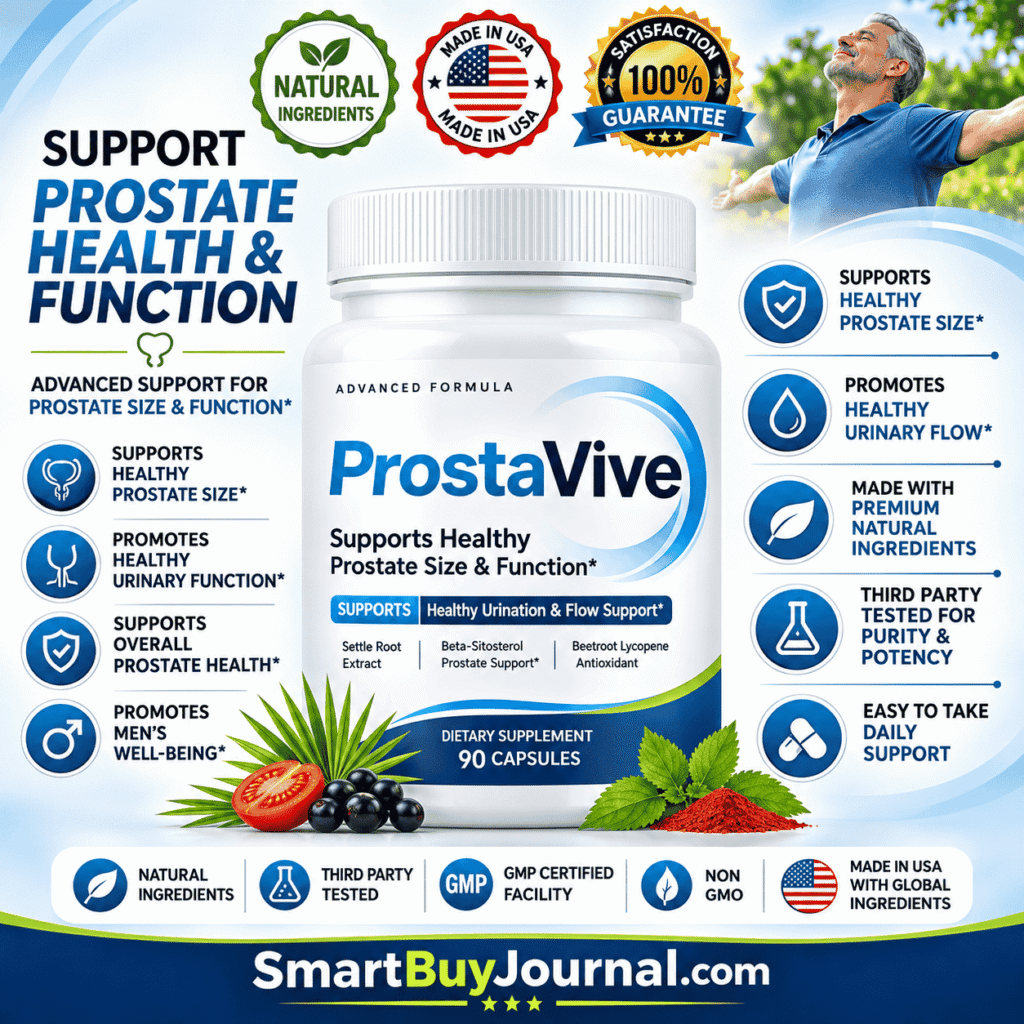
What ProstaVive is, according to its review page
ProstaVive is a prostate supplement we review on SmartBuyJournal. It is optional, and we are not saying you need it. Per its review page:
- Form: capsules, taken once daily.
- Ingredients: saw palmetto, beta-sitosterol, pygeum africanum, zinc and nettle root extract.
- No ingredient amounts are listed for any of them.
- Claims: improved urinary flow, fewer daytime and nighttime urinations, less urgency, and support for prostate hormone balance. The page says it is not a treatment for BPH, prostatitis or prostate cancer, and we do not claim it treats or prevents any prostate condition.
- No clinical trial of ProstaVive itself is presented, and the page cites no links for the ingredient evidence it describes.
- Not evaluated by the FDA. The page says it is not intended to diagnose, treat, cure or prevent disease.
What the research says about the ingredients
The NIH’s National Center for Complementary and Integrative Health reviewed several of these ingredients for BPH (NCCIH: BPH and complementary approaches). The page is from 2022, so newer research may not be reflected.
- Saw palmetto: mixed. A 2012 Cochrane review of 32 trials found no improvement in urinary flow or prostate size over placebo at two to three times the usual dose, while a 2020 meta-analysis found results similar to the drug tamsulosin on symptom scores. It is generally well tolerated, with possible mild stomach discomfort.
- Pygeum: limited. A 2002 Cochrane review of 18 trials suggested a standardized extract may be useful, but the trials were small, short and used varied preparations.
- Stinging nettle: limited. One 2005 trial of 620 patients reported improved symptoms over six months, and nettle’s tannins can reduce iron absorption, which matters for people taking iron.
- Beta-sitosterol and zinc: the NCCIH page does not cover them, and we did not find a source we could verify, so we make no claims about them. ProstaVive’s own page warns that very high zinc doses may interfere with copper absorption.
Things to know before buying
- Interactions. The page says to talk to a doctor before use, especially if you take medicines such as finasteride, dutasteride, tamsulosin or other alpha-blockers, or blood thinners.
- Mixed signals. The page calls the formula “evidence-grounded,” while also saying the nettle evidence is modest and that no trial tests the finished product. Its evidence ratings and verdict do not line up.
- Rating and reviews. It shows a 4.5 rating, but its four testimonials average 4.25, and its three comments look like spam and add no product information. We do not use the displayed rating.
- Price and guarantee. The page lists $79 (down from $99) for one bottle and a 60-day money-back guarantee. Bundle prices are not shown, so check current terms with the seller.
- Links. Purchase buttons go through an affiliate redirect, and the product appears under two slugs.
For the full analysis, read our ProstaVive review.
Affiliate disclosure: some links on this page are affiliate links, so SmartBuyJournal may earn a commission if you buy through them, at no extra cost to you. This does not change what we write. See our affiliate disclosure.
Frequently Asked Questions
What are the best foods for prostate health?
Vegetables (including tomatoes and cruciferous vegetables), fruit, legumes, whole grains and unsaturated fats are the most commonly suggested. The evidence is weak to moderate, and no food has been proven to prevent or cure prostate disease.
Are tomatoes among the best foods for prostate health?
Tomatoes are nutritious, but the National Cancer Institute describes the evidence that tomatoes or lycopene lower prostate cancer risk as weak.
Can the best foods for prostate health cure an enlarged prostate?
No. The NIDDK says no diet has been shown to cause or prevent BPH, though some habits, such as limiting alcohol and caffeine and timing fluids, can ease symptoms.
Is dairy off the list of best foods for prostate health?
The NCI found a small, borderline increase in prostate cancer risk with the highest dairy intake and says any increase may be small. Ask your doctor what is right for you.
Is coffee one of the best foods for prostate health?
Caffeine can worsen urinary urgency and frequency, so the NIDDK and MedlinePlus advise limiting it, especially in the evening.
Are prostate supplements better than the best foods for prostate health?
Evidence varies by ingredient, from mixed to limited, and supplements are not proven to prevent or cure prostate disease. Talk to your doctor before using one.
Does ProstaVive treat BPH?
No. Its own page says it is not a treatment for BPH, prostatitis or prostate cancer, and we do not claim it is.
When should I see a doctor about urinary symptoms?
See a doctor for any new or bothersome urinary symptom. Seek urgent care if you cannot urinate, see blood in your urine, or have fever with painful urination.
Conclusion: The Best Foods for Prostate Health in Short
The best foods for prostate health are not secret: vegetables, fruit, legumes, whole grains and healthy fats, with less red meat, alcohol and caffeine. They support your overall health, and they may ease some symptoms, but they do not prevent or cure prostate disease. Stay active, keep a healthy weight, and do not ignore urinary symptoms. If you notice changes, talk to a doctor.
Medical Disclaimer
This article is for general information only and is not medical advice, diagnosis or treatment. It is not written or reviewed by a physician. Urinary and prostate symptoms can be signs of serious conditions, including infection and cancer, so talk to a qualified healthcare professional before changing your diet, medications or supplements, particularly if you take medication or have a medical condition. Nothing here claims that any food or supplement prevents or cures prostate disease, and results vary.